







"You can only be free when you understand the whole process of your thinking and feeling."
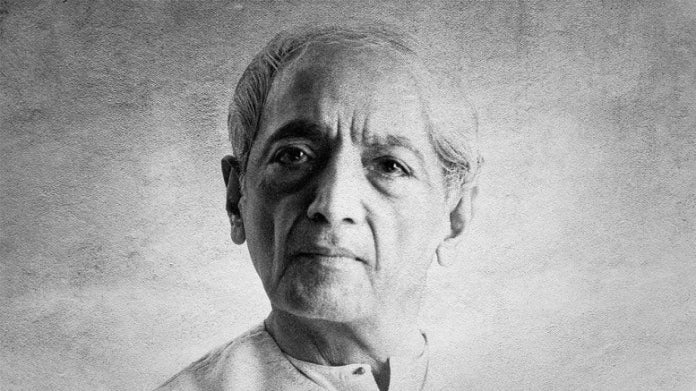
In 1929, before 3,000 disciples gathered in the Netherlands, a 34-year-old man performed one of the most revolutionary acts in modern spiritual history. Jiddu Krishnamurti, designated since childhood as the future "World Teacher," dissolved the Order of the Star created for him and renounced his messianic status.
"I maintain that truth is a pathless land," he declared that day, breaking the golden chains of organized spirituality.
Why does this Indian philosopher, who died in 1986, still fascinate those seeking mental freedom today? Why do his teachings resonate particularly with people suffering from anxiety, depression, or psychological distress that traditional medicine sometimes struggles to alleviate?
The answer may lie in this unique approach: Krishnamurti offers no method, no technique, no guru. He simply invites us to observe our thoughts with total attention, without judgment or resistance.
An extraordinary destiny in service of inner freedom
Born in 1895 into a poor family in southern India, Krishnamurti was "discovered" at 14 by Charles Leadbeater, an influential member of the Theosophical Society. Taken to England, educated as a future spiritual guide, he grew up in the shadow of this overwhelming predestination.
But in 1929, the unthinkable happened. Krishnamurti rejected everything: organization, title, disciples, and even the idea that one could follow another towards truth. He would spend the next 57 years traveling the world, teaching that secular spirituality begins with self-understanding, without intermediaries.
This radical break laid the foundation for his revolutionary philosophy: inner transformation can only come from direct observation of what is, without the intervention of any external authority.
Krishnamurti's 5 steps to mental freedom
1. Stop seeking: when the quest becomes a prison
"The problem is not to find an answer, but to understand the question."
Krishnamurti's first revelation overturns our usual approach: stop seeking solutions. This idea may seem paradoxical when suffering from anxiety or psychological disorders, but it is based on a deep observation of human psychology.
According to Krishnamurti, the constant search for solutions, methods, or answers keeps the mind in a state of permanent agitation. "The more you seek, the further you move away from what is," he explained in his lectures.
In practice: Instead of seeking to eliminate your anxiety, simply observe it. When it appears, instead of thinking "How do I get rid of it?", ask yourself "What exactly is it?"
Modern testimony: This approach finds surprising resonance in third-wave therapies such as ACT (Acceptance and Commitment Therapy), which advocate accepting anxiety rather than fighting it.
The link with neuroscience: Recent studies show that compulsive solution-seeking activates stress circuits in the brain, creating an anxiety loop. Acceptance, on the contrary, decreases amygdala activity.
2. Direct perception: seeing without the filter of words
"To observe without the observer is the highest form of human intelligence."
The second step consists of developing what Krishnamurti called direct perception. This involves observing one's thoughts, emotions, and reactions without naming, analyzing, or judging them.
This form of pure observation differs radically from classical introspection. When an emotion arises - anger, sadness, fear - the idea is not to analyze it but to look at it with the same attention one would give to a sunset.
In practice: When you feel irritation rising, don't think "I'm angry because...". Simply observe this energy in your body. Where does it manifest? How does it evolve?
Mini-dialogue inspired by the teachings:
- "But if I don't analyze, how will I understand?"
- "Analysis is time. Observation is instantaneous. In the instant, there is no problem."
Scientific convergence: This approach aligns with discoveries about mindfulness. MRI scans show that non-judgmental observation modifies prefrontal cortex activity and reduces emotional reactivity.
3. Understanding fear: observing it to dissolve it
"Fear exists only in relationship to something."
For Krishnamurti, fear is the fundamental poison of the human mind. It feeds on two elements: memory (fear based on the past) and imagination (fear projected into the future).
His method for dissolving fear is not to fight it, but to understand it completely through observation. "What you completely observe disappears," he asserted.
In practice: When fear appears, do not flee. Observe it physically: tension in the chest, accelerated heartbeat, abdominal contraction. Also observe its mental structure: what exactly are you afraid of? Judgment? Failure? Death?
Revealing anecdote: One day, during a lecture, someone asked Krishnamurti: "How can I get rid of my fear?" He replied: "You cannot get rid of it. You can only understand it. And when you understand it completely, it is no longer there."
Impact on the brain: Conscious observation of fear activates the prefrontal cortex, which regulates the amygdala. This is the principle of "name it to tame it" in neuroscience: naming and observing an emotion naturally regulates it.
4. The end of psychological time: living in the present moment
"Psychological time is the enemy of man."
Krishnamurti distinguished chronological time (necessary for practical activities) from psychological time (mental projection into the past and future). According to him, all mental suffering arises from this temporal projection.
Anxiety, for example, is always linked either to regret for the past or apprehension about the future. In the pure present moment, without the contamination of psychological time, there is no psychological problem.
In practice: When anxiety rises, return to immediate sensations: your feet on the ground, your breath, the sounds around you. Ask yourself: "What is actually happening now?" Often, you will discover that the immediate present is peaceful.
Enlightening quote: "Yesterday is but today's memory, and tomorrow is today's dream. But today, well lived, makes every yesterday a dream of happiness and every tomorrow a vision of hope."
Influence on Bruce Lee: The famous martial artist, deeply influenced by Krishnamurti, developed his "be water" philosophy and spontaneous action from these teachings on the present.
5. Freeing oneself from the known: transcending conditioning
"The conditioned mind can never be free."
The fifth and final step concerns liberation from conditioning. Krishnamurti observed that we live according to inherited mental patterns: education, culture, past experiences, beliefs. This conditioning, though sometimes useful, limits our perception and our capacity for response.
"To see is to transform," he said. The simple awareness of our conditioning begins to free us from it. It is not about violently rejecting them, but about observing them with clarity.
In practice: Observe your automatic reactions. When someone criticizes you, what is your usual response? Defense? Attack? Withdrawal? This non-judgmental observation reveals conditioned patterns and allows for the emergence of more creative responses.
Concrete example: If you learned that "to cry is to be weak," observe this belief. Where does it come from? Is it true? This simple observation can release a natural emotion long suppressed.
Link with Aldous Huxley: The author of Brave New World, a close friend of Krishnamurti, drew inspiration from this approach to develop his vision of humanity freed from social conditioning.
Convergences with modern science
Krishnamurti's teachings, developed long before the rise of neuroscience, are now finding surprising confirmations:
- Neuroplasticity confirms that conscious observation changes brain structure
- Mindfulness, now scientifically validated, adopts its principles of non-judgmental observation
- Acceptance and Commitment Therapy (ACT) is directly inspired by his "non-doing" approach
- Research on flow aligns with his description of spontaneous action without ego
Practical tips for integrating the 5 steps
Daily
- Morning: Start the day with 5 minutes of silent observation of your thoughts
- Stress: When faced with a stressful situation, ask yourself: "What is actually happening now?"
- Relationships: Observe your automatic reactions without justifying or condemning them
- Evening: Before sleeping, observe the day without judgment, like watching a movie
Pitfalls to avoid
- Do not turn observation into a rigid technique
- Do not expect immediate results
- Do not judge yourself if you forget to observe
- Do not make Krishnamurti a new guru to follow
Cultural impact and modern legacy
Krishnamurti's influence extends far beyond spiritual circles. His ideas have inspired:
- Bruce Lee and his philosophy of Jeet Kune Do
- David Bohm, quantum physicist, in his research on consciousness
- Silicon Valley and its approach to creative innovation
- Humanistic therapies and their vision of patient autonomy
- Alternative education with Krishnamurti schools worldwide
Revolutionary simplicity
What is striking about Krishnamurti's approach is its radical simplicity. No mantras, no rituals, no expensive initiations. Just the invitation to look at what is, without interpretation.
This simplicity is not poverty but richness. As he often said: "It takes extraordinary intelligence to see what is simple."
Conclusion: freedom as an endless path
"You are the world and the world is you. When you transform yourself, the world transforms."
Jiddu Krishnamurti bequeaths to us more than a philosophy: an art of living based on lucid and benevolent observation of what is. His 5 steps towards mental freedom are not a method to be applied mechanically, but an invitation to explore our own consciousness with curiosity and courage.
In a world where anxiety and psychological suffering are exploding, where external solutions are multiplying without always bringing relief, his voice resonates with disturbing topicality. It reminds us that true healing comes not from a therapist, nor from a medication, nor from a technique, but from our innate ability to clearly see what is happening within us.
Inner freedom is not a goal to be achieved but a space to be discovered, here and now, in the silent intimacy of our own consciousness.
Key takeaways
The 5 essential steps:
- Stop seeking - The quest maintains agitation
- Observe directly - See without analyzing or judging
- Understand fear - Total observation dissolves it
- Exit psychological time - Live in the present moment
- Free yourself from conditioning - See your automatic patterns
The essential: No method, no guru, just attentive observation of what is. Transformation arises naturally from understanding.
Final quote: "Freedom is not at the end, freedom is at the beginning." - Jiddu Krishnamurti






Share: